Custom ERP vs Standard ERP
Which One Is Actually Right for Your Business?
It's one of the most common stories in business today. A company invests in ERP software — months of evaluation, a significant budget, a long implementation — and two years later, half the team has quietly drifted back to Excel. The software works, technically. It just doesn't work for them.
The root cause, more often than not, is a mismatch between how the software was built and how the business actually operates. That gap is exactly what the debate around custom ERP vs standard ERP is all about.
Enterprise Resource Planning software has become essential infrastructure for any business that wants to run efficiently, scale intelligently, and make decisions based on real-time data rather than gut feeling. But "ERP" is not one thing. There's a wide spectrum — from rigid, off-the-shelf systems designed for the average company, to fully customizable ERP solutions built around the unique realities of your industry.
The truth is, there's no universal answer. The right choice depends on your operations, your industry, your growth plans, and how much your workflows diverge from the generic. What this guide will do is help you understand both sides clearly — so you can make an informed decision, not a regretful one.
What Is an ERP System?
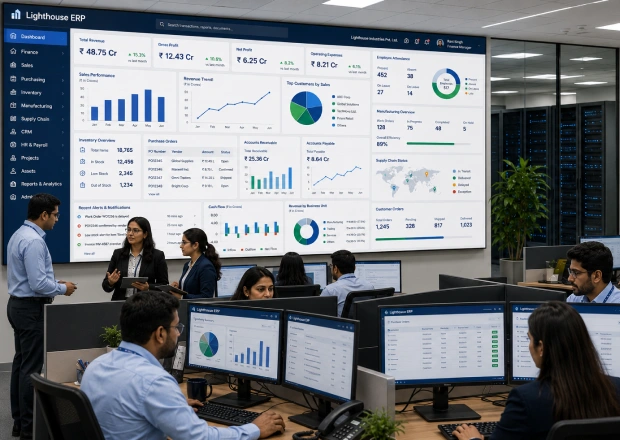
At its core, an ERP (Enterprise Resource Planning) system is software that integrates all the key functions of a business into a single, connected platform. Instead of your finance team working in one tool, your warehouse in another, and your HR in a third — an ERP brings everything together so data flows freely, nothing falls through the cracks, and decision-makers can see the full picture in real time.
A modern ERP typically covers: finance and accounting, inventory and warehouse management, procurement and supply chain, production planning, HR and payroll, sales and CRM, and business intelligence and reporting. In 2026, the best ERP for manufacturing also offer mobile access, cloud deployment, API-based integration with third-party tools, and AI-driven insights that surface problems before they become crises.
The strategic value is clear: one source of truth, better visibility, reduced manual effort, and the ability to scale without your operations collapsing under their own complexity. The question isn't whether you need an ERP. It's which kind.
Understanding Standard ERP Software
Standard ERP — also called off-the-shelf or packaged ERP — is pre-built software designed to serve a broad range of businesses out of the box. Think of it as a ready-made suit: well-constructed, generally functional, and available immediately. Global names in this space include SAP Business One, Oracle NetSuite, Microsoft Dynamics 365, and Tally Prime. They're well-known because they work reasonably well for a wide audience.
The underlying model is simple: the vendor builds a comprehensive set of modules covering common business processes, and companies configure those modules to approximate their needs. You're not starting from scratch — the logic, workflows, and reports are already there.
| Advantages | Limitations |
|---|---|
| Lower upfront cost and licensing fees | Rigid processes — the business adapts to software, not vice versa |
| Faster implementation timeline | Limited deep customization without expensive add-ons |
| Regular vendor-driven updates and patches | Feature bloat — paying for modules you never use |
| Proven reliability with large user communities | Poor fit for niche or complex industry workflows |
| Easier to find trained support staff | Workarounds accumulate over time, eroding efficiency |
One of the biggest drawbacks of standard ERP software is that it was built for a hypothetical average company — not yours. If your operations involve weight-based pricing, multi-stage batch production, heat-number tracking, or any process that doesn't fit a generic template, you'll hit a wall quickly.
Understanding Custom ERP Software
Custom ERP software is designed — either built from the ground up or deeply configured — to match exactly how your business operates. Instead of reshaping your processes to fit the software, the software is shaped to fit your processes. In the best implementations, users barely feel like they're using enterprise software at all; it just feels like the way work gets done.
Custom ERP can mean fully bespoke development, but it more commonly refers to highly configurable platforms that come with industry-specific logic already built in — and enough flexibility to adapt to each business's unique requirements without starting from scratch every time.
| Advantages | Limitations |
|---|---|
| Perfect fit for your workflows and industry terminology | Higher initial investment compared to off-the-shelf |
| Competitive edge — competitors can't replicate your exact system | Longer implementation timeline due to discovery and configuration |
| Seamless integration with existing tools and infrastructure | Requires an experienced, committed implementation partner |
| Scales precisely with your business growth | Ongoing maintenance needs a responsive vendor relationship |
| Higher user adoption — familiar, intuitive processes |
The benefits of custom ERP become most visible over time. Every workaround eliminated, every manual report automated, every process that now runs without human intervention — those savings compound. Businesses in specialized sectors like steel manufacturing, metals trading, or batch production consistently report that a well-configured ERP pays for itself within two to three years.
Custom ERP vs Standard ERP: The Full Comparison
| Factor | Standard ERP | Custom / Configurable ERP |
|---|---|---|
| Upfront Cost | Lower — licensing + standard setup | Medium–Higher — reflects custom scope |
| Implementation Time | Faster for basic setups | Longer — thorough discovery & configuration |
| Process Fit | Low–Moderate — you adapt to it | High — software adapts to you |
| Customization Flexibility | Restricted — expensive to modify deeply | High — core strength |
| Scalability | Tied to vendor roadmap | Scales with your business |
| Industry-Specific Features | Generic modules | Deep, built-in industry logic |
| Integration | Standard APIs — may need middleware | Designed around your ecosystem |
| Security & Compliance | Vendor-defined controls | Customized to your regulatory context |
| Maintenance & Upgrades | Vendor-managed, may break customizations | Controlled, planned updates |
| User Adoption | Moderate — retraining required | Higher — familiar workflow logic |
| Long-Term ROI | Variable — hidden costs erode savings | Typically stronger — compounds over time |
Real-world scenario: A mid-size steel manufacturer switches from a standard ERP to a configurable one. Within the first year, they eliminate 4 manual Excel reports, automate heat-number tracking across dispatch, and reduce inventory reconciliation time by 60%. The upfront cost was 30% higher — but the operational gains outweighed it within 18 months.
Another scenario: A 12-person services company with straightforward invoicing, basic HR, and standard procurement adopts an off-the-shelf ERP. It deploys in 8 weeks, the team learns it in a few days, and it handles everything they need. For them, a custom system would have been overkill.
The key takeaway: complexity and industry specialization are the deciding variables, not company size alone.
When to Choose Custom ERP Over Standard ERP (and Vice Versa)
Rather than a rigid rule, think of this as a decision framework. Ask yourself these questions honestly:
| Go Standard If… | Go Custom / Configurable If… |
|---|---|
| Your processes are simple and generic | You're in manufacturing, steel, metals, or industrial sectors |
| You're a small team under 50 people | You have multi-site, multi-branch, or group company operations |
| Budget is very tight and speed matters | Your costing, quality, or inventory is highly specialized |
| You operate in services or retail with common workflows | You've outgrown a generic ERP or are building for scale |
| You don't anticipate significant operational complexity | Competitive differentiation depends on operational excellence |
Industry-specific examples: A batch chemical manufacturer tracking formulas, shelf life, and regulatory compliance needs custom ERP — standard software cannot manage recipe-based production with the required depth. A discrete manufacturer building equipment to order needs ERP that understands job costing and BOM-based production, not just sales orders. A steel trading company dealing with weight-based pricing, quality grades, and multi-warehouse dispatch needs software built around those exact realities.
In contrast, a trading company with simple buy-sell operations, uniform SKUs, and standard invoicing could function well on an off-the-shelf platform without significant pain.
The honest answer is: if your business is specialized, the question isn't whether you can afford custom ERP — it's whether you can afford not to have it.
Lighthouse ERP: The Flexible, Configurable Solution for Diverse Industries
Understanding the difference between custom and standard ERP is valuable. But what most businesses actually need is something the debate rarely surfaces — a solution that sits intelligently between the two: a mature, proven platform that arrives with deep industry-specific logic already built in, and the flexibility to configure precisely to your business without charging you for a full bespoke build.
That's what Lighthouse ERP has been delivering for over 39 years.
Founded with the conviction that no two companies are the same — and neither should be their enterprise software — Lighthouse was built from the ground up for the operational realities of Indian manufacturing and industrial businesses. The platform covers ERP, CRM, HRM, Business Intelligence, and Mobile Solutions under one roof, with modules purpose-built for industries that standard software typically handles poorly.
Why Lighthouse Is the Best of Both Worlds
Unlike standard ERP that forces you to fit a template, and unlike fully bespoke development that carries enormous cost and risk, Lighthouse offers a third path:
- A mature, Oracle-based platform tested across 1000+ real implementations
- Pre-built, deep functionality for your specific industry — not generic modules
- High configurability so the software matches your exact workflows
- Real-time dashboards and Business Intelligence for data-driven decisions
- Seamless integration across branches, plants, group companies, and third-party systems
- Mobile access so operations stay connected wherever work happens
Conclusion & Next Steps
The most important thing to take away from this guide is simple: choosing an ERP is not a software decision — it's an operational decision. The right system should reflect how your business works, support how it's growing, and make life genuinely easier for the people who use it every day.
If you're in manufacturing, steel, metals, infra, or any industrial sector where the details of your process matter, don't compromise on fit. The cost of a year spent fighting software that doesn't understand your business is far greater than the difference in implementation price.
Start with a clear picture of your current pain points, your five-year trajectory, and the workflows that make your operation unique. Then find the platform that was built for businesses like yours — not despite them.