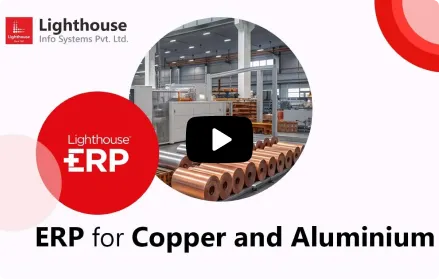
ERP for Aluminium and Copper Alloy Casting Industry

ERP for Aluminium and Copper Alloy Casting Industry

Aluminium is heavily used in electrical power transmission, machinery and equipment, and construction. Most aluminum manufacturers and producers have access to captive power, affordable labor, and proximity to raw materials like bauxite.

The global aluminum market was worth 19.1 Mn MT in 2019. Looking forward, the market is forecast to reach a volume of 24.3 Mn MT by 2025.

Lighthouse ERP for Aluminium Alloys and Casting Industry is designed to handle complete needs in the most efficient, effective, and accurate way. Since 1987, Lighthouse ERP has continuously evolved, and the company is committed to providing an industry-specific, comprehensive, and robust solution for the aluminum sector and also as a best erp for manufacturing Industry. Lighthouse ERP’s technical expertise and in-depth mapping of key industry requirements are the foundation of its success. The Lighthouse ERP for Aluminium and Copper Alloys Casting , Aluminum extrusion provides complete visibility across the supply chain, with integrated modules for logistics, inventory, and financials.

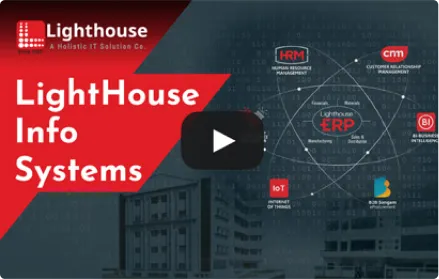
Lighthouse ERP for Aluminium Alloys and Casting Industry
lighthouseindia
lighthouseindia

Challenges of Aluminium & Copper Alloy Casting Industry

Workforce Management Issues

Workforce Management Issues

Casting operations require skilled labour, but managing shift schedules, productivity, & process adherence can be difficult and time-consuming.

Raw Material Procurement & Logistics

Raw Material Procurement & Logistics

Procuring aluminium or copper alloys & transporting them to the plant is prone to delays, especially due to climatic disruption or supply chain inconsistencies.

Operational Complexity in Extrusion & Casting

Operational Complexity in Extrusion & Casting

Although the extrusion process may seem simple, it involves high precision & pressure control, making it complex to manage without real-time monitoring and planning tools.

Unmonitored Production Delays

Unmonitored Production Delays

Manual planning of production press, work orders, or die management may result in extended production cycles & inefficiencies.

Lack of Integrated Process Visibility

Lack of Integrated Process Visibility

Without centralized control, industries struggle to monitor different stages of casting procurement, production, quality testing, and dispatch, leading to potential process gaps.

Key Benefits of ERP for Aluminium & Copper Alloy Casting

Benefits of ERP in Aluminium & Copper Alloy Casting
  • Streamlined Workforce & Operations Management

    Lighthouse ERP for aluminium and copper Alloy Casting automates work orders and manages labour allocation efficiency, reducing manual oversights.

  • Efficient Production Press Planning

    ERP for Aluminium Industry enables detailed planning of each production batch, reducing idle machine time and improving throughput.

  • Automated Bill Generation

    Process-specific billing is automated, minimizing manual errors and speeding up financial operations.

  • Centralized Process Control

    Aluminium Casting ERP software gives complete control and visibility over operations from raw material procurement to finished goods, ensuring timely interventions.

  • Customized to Industry Needs

    Lighthouse ERP solution for copper alloys casting is tailored specifically for the aluminium and copper alloy industry, ensuring the system matches the real-time operational needs.

  • Maximized Operational Speed and Output

    With reduced delays and better coordination across departments, ERP software helps in achieving higher production efficiency.

  • Adaptability to Modern Industrial Demands

    As an evolving solution, Lighthouse ERP keeps up with new trends, compliance needs, and customer expectations.

Key Features of Lighthouse ERP for Aluminium and Copper Alloys Casting Industry

icon

Quality Control Traceability

Track Heat/Cast-wise quality checks with precise MIS reports. Maintain traceability of finished goods back to the input raw material heat, and its quality test certificate.

icon

Efficient Supply Chain Management

Calculate raw material costs based on aluminium scrap types and recovery rates. Monitor every material movement from gate entry to storage, ensuring full traceability and inventory accuracy.

icon

Granular Stock Visibility at Every Stage

Gain real-time visibility of material stock across key zones: raw material yard, crusher, feeder, discharge points, and bagging areas for streamlined plant operations.

icon

Comprehensive Financial Management

Manage costing per ton based on raw material, fuel, electricity, and consumables. Get division-wise financial control with consolidated ledgers, profitability tracking, and mould life accounting.

icon

Advance MIS with Multi-level Drill-down

Access detailed stock and financial data through a 10-level drill-down: from Group → Entity → Division → Plant → Dept → Cost Center → Equipment → Item Group → Item → Issue Slip.

icon

Effective Production Planning and Control

Handle aluminium ingot or section remelting heat-wise, with control over size, lot, and godown. Track WIP and semi-finished goods with batch-wise pricing.

icon

Real-Time Control of Casting Condition

Create accurate BOMs, plan material requirements, and define monthly production schedules. Monitor real-time process parameters (e.g., temperature, pressure) analyze yield variance.

icon

Waste and Breakdown Analysis

Log equipment breakdowns shift-wise and date-wise. Implement effective waste recycling strategies to reduce production loss.

icon

Smooth 3-Step Sales Workflow

Support a 3-stage sales cycle: Enquiry, Order, and Delivery. Generate invoices instantly linked to weigh slips and delivery orders. Enable flexible pricing with discounts and credit controls.

icon

Die Management System

Track die purchase and production usage. Maintain detailed die history cards with fault analysis, root causes, and corrective actions.

Frequently Asked Questions About ERP for Aluminium and Copper Alloy Casting Industry

It's an ERP designed for casting operations that melt and recast aluminium or copper alloys — covering scrap procurement, heat-wise production, quality testing, and a sales process running from enquiry through to delivery. It connects the shop floor (furnaces, casting, dies) with inventory, finance, and dispatch in one system.

Each heat or cast gets its own quality checks and MIS reporting, with finished goods traceable back to the input raw material heat and its quality test certificate. This heat-wise traceability is especially useful when a customer raises a quality concern, since the plant can pinpoint exactly which production run is involved.

Different types of aluminium or copper scrap yield different amounts of usable metal after melting, and the ERP factors these recovery rates into raw material costing. This gives a more accurate picture of the real cost per ton of output than simply using the purchase price of the scrap input.

It's a reporting structure that lets users drill from a high-level group view down to individual issue slips, passing through entity, division, plant, department, cost center, equipment, and item-group levels along the way. A manager looking at an overall cost figure can trace it down to the specific transaction behind it.

Process parameters during casting are captured as the run happens and compared against yield variance expectations, rather than being recorded after the fact from operator notes. Monitoring this in real time helps identify when a casting run is drifting from normal conditions before it results in off-spec output.

It follows a three-stage process — enquiry, order, and delivery — with invoices generated automatically and linked to weigh slips and delivery orders. Pricing flexibility, including discounts and credit controls, is built into this workflow, so sales teams aren't switching between separate systems for quoting, invoicing, and credit checks.

Yes — the system tracks die purchases and how each die is used in production, maintaining a history card per die that records faults, root causes, and corrective actions taken. Over time, this history helps identify dies that are underperforming or due for replacement based on actual usage data rather than guesswork.