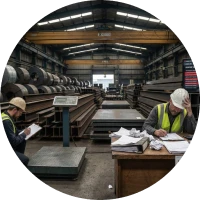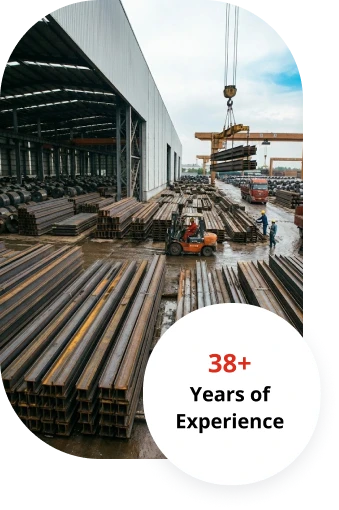
Driving the movement and distribution of steel products like longs, flats, coils, TMT bars, structural steel, and metal scrap across diverse industrial sectors, steel traders operate in a highly competitive environment. Successful steel trading and distribution demands precise control over purchasing, sales, steel stock management, inventory tracking, dynamic pricing, and steel logistics, where even minor inefficiencies can directly impact profit margins.
To tackle these challenges, ERP for steel trading delivers a unified digital framework that connects every function from procurement to dispatch. It enables traders to monitor material specifications, manage grades and sizes, track pricing fluctuations, and respond instantly to customer demand through real-time analytics and automation, an essential capability for wholesale steel trading and steel supply chain management.
Sectors like construction, automotive, aerospace, defense, rail infrastructure depend heavily on uninterrupted industrial steel supply. Lighthouse ERP, with domain expertise since 1987, delivers an industry-specific ERP solution for steel traders. The system automates core business functions including purchase, sales, finance, and inventory while offering actionable insights, cost control, and built-in compliance management tailored for steel trading companies.
As India cements its position as a global steel trading hub. Lighthouse ERPs dashboards and analytics reduce operational risks, and respond quickly to market changes driving higher efficiency, better financial control, and sustainable growth in the competitive trading industry.
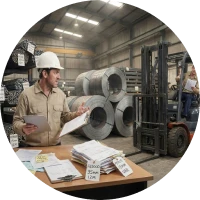
Steel is traded by weight (MT, KG, or coil weight), but orders are raised by theoretical weight or dimensions. This causes manual reconciliation during dispatch, leading to billing disputes and inaccurate valuation.
Each steel product (like TMT bars, coils, or sheets) can have multiple grades, lengths, and finishes. Manual handling of such variants causes errors in dispatch, incorrect order picking, and customer dissatisfaction.
Steel trading often involves returns, rejections, or scrap material with variable quality. Tracking rejected lots, resale, and conversion of scrap manually leads to loss of material traceability and financial leakage.
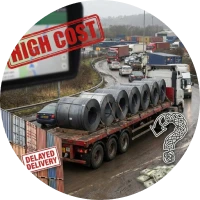
Steel is heavy and costly to transport. Without freight contract visibility or delivery route optimization, companies face high transportation costs and delayed deliveries.
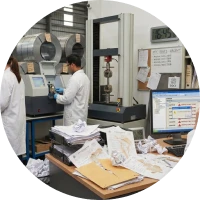
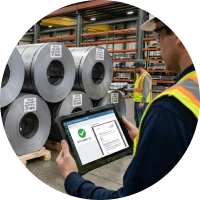
Different customers (like automotive or construction companies) demand mill test certificates (MTCs) or lab test reports for every batch. Manual certificate tracking is difficult.
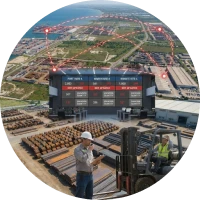
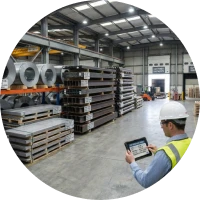
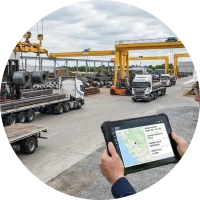
Steel stock is often stored across yards, ports, and warehouses. With centralized system, tracking available stock and movement between locations becomes easy.
Steel trading involves multiple dealers, sub-dealers, and bulk buyers with complex credit limits and payment cycles. Manual tracking leads to delayed collections and blocked capital.
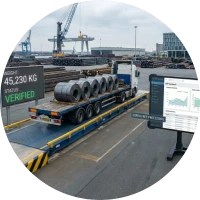
ERP automates weight-based billing by integrating with weightbridge systems called as weighbridge ERP integration, capturing actual weight at the time and invoices, stock, and costing in real time eliminating mismatch errors.
ERP maintains item masters with multiple attributes such as grade, gauge, thickness, and finish. It ensures accurate order picking, better classification, and full traceability from supplier to customer.
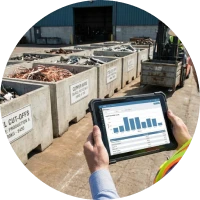
The system digitally manages scrap material recording source, weight, and resale value. It integrates scrap into stock valuation and allows real-time reporting on profit recovered from scrap sales.
Adopting Logistics module in ERP, integrates freight management with dispatch and invoicing. It tracks transport contracts, freight rates, and shipment status, ensuring cost-effective logistics and timely customer delivery.
ERP links quality certificates directly to heat numbers, coil IDs, or batch numbers. It ensures every delivery is accompanied by the correct test document, improving customer trust and audit readiness.
ERP provides a unified view of stock across all locations, including weight, grade, and form. Inter-yard transfers, loading slips, and delivery status are updated in real time for complete control.
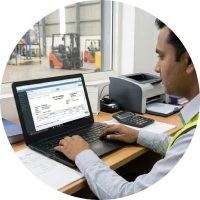
ERP ensures compliance by auto-generating GST invoices, e-way bills, and filing-ready reports. It also provides audit logs for every transaction for smooth financial governance.
Automates buying, selling, pricing, and dispatch of steel products for smooth workflow and full visibility.
Minimizes manual work, reduces delays, and cuts administrative costs through end-to-end automation.
Connects inventory, finance, logistics, and HR for real-time data flow and coordinated operations.
Tailored modules for steel trading including weight-based billing, grade tracking, and scrap management.
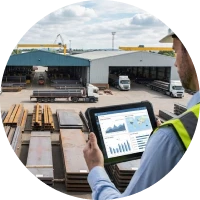
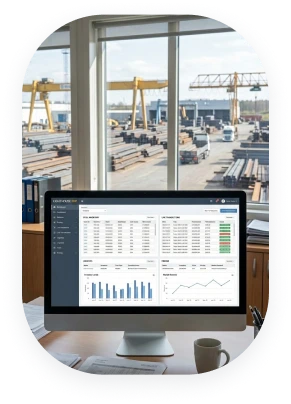
Trading companies gain real-time KPI like Gross Margin, Inventory Turnover, Order Fulfillment Cycle Time, Supplier Lead Time, and Working Capital Cycle. Helping decision-makers to improve profitability, stock efficiency, supplier performance and customer service.